
I noticed that. To think she deliberately went out to acquire that t-shirt (probably had a bespoke one made) because she knew how much controversy the Lush window caused. She is nothing but a troll who will do anything for attention.For anyone who cannot stomach viewing the evil creature, she’s wearing a T shirt featuring that Lush, “Proud of my stripes” tiger cartoon with the mastectomy scars.

- Status
- Thread locked. We start a new thread when they have over 1000 posts, click the blue button to see all threads for this topic and find the latest open thread.
New to Tattle Life? Click "Order Thread by Most Liked Posts" button below to get an idea of what the site is about:

The way that vile creature keeps interrupting and accusing Julia of using "emotive language". Does she actually mean, factual language? Does it spell things out too plainly? Does it make what Webberly believes sound as appalling as it actually is?This is an excellent watch with Julia grilling Helen who either doesn’t answer the question or gives a tonne of word salad
I can't watch Webberley. I'm not a psychiatrist but I'd bet my life savings she has a cluster B personality disorder. The total lack of insight, the arrogance, the absence of empathy, the total imperviousness to logic. Nothing behind the eyes.This is an excellent watch with Julia grilling Helen who either doesn’t answer the question or gives a tonne of word salad
Her commitment to humiliating herself is pathological in itself.
Also what the duck has she got on?
Well if you can't argue with the content of someone's message then talking about their tone is a good distraction.The way that vile creature keeps interrupting and accusing Julia of using "emotive language". Does she actually mean, factual language? Does it spell things out too plainly? Does it make what Webberly believes sound as appalling as it actually is?
Honestly, even if I was all TWAW, I'd watch her and be like, do we want this incoherent maniac on our side? Do we think she sounds reasonable?
I would be shocked if it didn't emerge that there is a trans person somewhere in Hales family. I'm glad shes no longer a Judge, she comes across like an American Supreme Court judge whos able to twist the law whatever way suits their ideology rather than looking at it objectively.

 archive.ph
Also if biological sex doesn't exist then why on earth is it any achievement that she was the first female President of the Supreme Court?
Trans row: Former Supreme Court judge who denied biological sex exist…
archived 30 Jun 2026 09:01:19 UTC
Also if biological sex doesn't exist then why on earth is it any achievement that she was the first female President of the Supreme Court?

Anyone seen the letter KJK has written to the Met after her event on Saturday was moved.

BIB - A titless tiger - it's Lush!I can't watch Webberley. I'm not a psychiatrist but I'd bet my life savings she has a cluster B personality disorder. The total lack of insight, the arrogance, the absence of empathy, the total imperviousness to logic. Nothing behind the eyes.
Her commitment to humiliating herself is pathological in itself.
Also what the duck has she got on?


Oh, man. She was the guest on the Lucy Worsley podcast I recommended earlier today! It was a different episode but I had no idea she was such a twanger.I would be shocked if it didn't emerge that there is a trans person somewhere in Hales family. I'm glad shes no longer a Judge, she comes across like an American Supreme Court judge whos able to twist the law whatever way suits their ideology rather than looking at it objectively.
Trans row: Former Supreme Court judge who denied biological sex exist…
archived 30 Jun 2026 09:01:19 UTC
Also if biological sex doesn't exist then why on earth is it any achievement that she was the first female President of the Supreme Court?
Also - if biological sex doesn't exist, what do people think they are transitioning from and to? There is no sex. So what does "transition" mean? How can someone "transition"? Why would they want to? What difference would it make?I would be shocked if it didn't emerge that there is a trans person somewhere in Hales family. I'm glad shes no longer a Judge, she comes across like an American Supreme Court judge whos able to twist the law whatever way suits their ideology rather than looking at it objectively.
Trans row: Former Supreme Court judge who denied biological sex exist…
archived 30 Jun 2026 09:01:19 UTC
Also if biological sex doesn't exist then why on earth is it any achievement that she was the first female President of the Supreme Court?
Do you have a link, please?Anyone seen the letter KJK has written to the Met after her event on Saturday was moved.
Open letter to the Met.
Dear Commander Smart: Is Tower Hamlets a Place Where Women Are Allowed to Speak?
For the last few years I have travelled around Britain organising events where women gather in public to speak about women’s rights, safeguarding, freedom of speech and the reality that sex matters. (I’ve actually travelled around the world and witnessed policing in places as far as Auckland and Rio de Janeiro.) They are not riots, they are not threats to public order and they are not designed to intimidate anybody. They are simply women speaking in public about matters that affect women and girls.
Yet increasingly I have come to the conclusion that, in the eyes of parts of British policing, women speaking publicly is itself treated as the problem.
When we sought to hold an event in Whitechapel, we wanted to do what free speech campaigners have always done: gather somewhere visible, somewhere accessible and somewhere that ordinary members of the public might hear us and engage with what we had to say. Whitechapel was not chosen by accident. Part of the reason we chose it was because we know that there are parts of Britain where certain opinions cannot be expressed or where certain groups of people should quietly avoid speaking in public and we are told these places do not exist.
We are constantly told that Britain has no no-go areas, that the rule of law applies equally everywhere and that everyone enjoys the same rights and freedoms regardless of which street they happen to be standing on.
We wanted to test whether that was true.
Instead we were informed that, for the sake of “community tensions”, we would have to hold our event in a park some distance away from where we had intended. Public speech hidden away from the public rather defeats the object.
We were further informed that if we entered Whitechapel to hold our event as planned we risked arrest for breaching the conditions imposed upon us.
The practical message appeared to be that women were free to speak, provided we did so somewhere else. In this case, a park far far away.
We were informed that Stand Up To Racism intended to protest the event and that approximately 500 demonstrators were expected to attend. We also told that Tower Hamlets Council had informed the Metropolitan Police that as many as 20,000 protesters could arrive in opposition to women gathering to speak publicly.
Twenty thousand.
If those figures influenced operational decisions then I think the public deserves answers. Did these estimates contribute to the decision to move us from our chosen location? Did they contribute to the Section 14 conditions imposed upon our event? What intelligence supported those predictions and, now that the event has passed, does anybody seriously believe they reflected reality?
Because if public authorities can justify restrictions on unpopular speech simply by predicting enough opposition to it, then freedom of expression exists only at the pleasure of whichever group can threaten the largest protest.
That is not democracy. It is the heckler’s veto with official paperwork attached to it.
The consequence of this approach was that the women wishing to exercise their lawful right to speak found themselves restricted as to where they could stand and when they could assemble, while those seeking to stop us speaking appeared to face no equivalent restrictions at all. We cooperated fully with the police and complied with the conditions placed upon us, yet protesters were still able to approach closely enough to scream through speeches and attempt to drown out women’s voices.
Had some of the women present not stood their ground, our event would simply have been shouted down.
I find myself wondering what lesson the Metropolitan Police intended women to take from this experience. That we may speak, but only where we are told. That we may speak, but only if enough people do not object. That women discussing safeguarding and women’s rights are to be managed, while those threatening disruption are simply an unfortunate reality that everyone else must accommodate.
There is another possibility that I find myself increasingly considering, and it is one that should concern anyone who cares about equal treatment under the law. Have the police, in some circumstances, simply concluded that enforcing the same standards everywhere, against everyone, is too difficult, too resource intensive or too politically sensitive, and that it is therefore easier to restrict those who are willing to cooperate than those who may not be?
From the perspective of those subjected to these restrictions, it can sometimes feel as though policing has become an exercise in managing the compliant rather than confronting the disruptive. The organisers who engage with police, follow instructions and obey the law find themselves moved, restricted and regulated, while those threatening disorder acquire influence simply through their willingness to create problems.
Many members of the public will look at situations such as this and conclude that certain communities or activist groups are treated with a degree of caution or accommodation that would not be extended elsewhere, not because police officers agree with them, but because confronting them and policing them robustly is judged to be too difficult, too costly or too likely to create further problems.
Whether that perception is fair or unfair, it exists.
It also raises an uncomfortable question that police leaders should perhaps be willing to answer openly: are the police still controlling the streets, or are they increasingly managing public order according to which groups are easiest to police and which groups are most likely to create difficulties if challenged?
After several years of experiences like this, I have reached an uncomfortable conclusion. I increasingly believe that many police officers approach these events having already decided who the aggressors are before the first officer arrives on scene. Women speaking publicly about the erosion of their rights are viewed as provocative, while those seeking to silence them are viewed as reacting to provocation rather than creating it.
Once you begin from that assumption, every decision that follows becomes easy to justify.
Move the women.
Restrict the women.
Manage the women.
The protesters can largely look after themselves.
The day after this event I experienced something that was neither hypothetical nor speculative. A man approached me and asked whether I intended to continue “talking tit about Islam”. When I replied that I did, he told me, “I’m going to cut your throat.” The exchange was captured on video.
If charges follow, he will become the fourth man charged with offences against me in the United Kingdom in the last three years because of my public campaigning.
That is one of the reasons I find this approach so difficult to understand. Time and again it feels as though the authorities are more concerned with managing, or not managing, the reaction to women speaking than with protecting the women who are speaking. Genuine threats against women who speak publicly seem to be regarded as an unfortunate occupational hazard, while the women themselves are treated as the public order problem.
I am also troubled by reports of Metropolitan Police LGBT training sessions in which my name was mentioned and officers were allegedly encouraged to boo and hiss. If true, that should concern every Londoner, regardless of whether they agree with me or disagree with me. Police officers are entitled to hold political opinions like everybody else. They are not entitled to allow those opinions to influence the policing of lawful speech and assembly.
Impartiality matters most when police disagree with the people they are policing.
Which brings me to my final question: is Tower Hamlets a place where women can safely gather and speak in public?
Because I intend to return.
I intend to speak in Tower Hamlets again, and I intend to do so somewhere that people can hear us. Perhaps on the steps of the Town Hall itself. Perhaps somewhere else in the borough. The location matters less than the principle.
Will the Metropolitan Police facilitate lawful speech or facilitate its suppression?
Will women once again be moved out of sight for the sake of “community tensions”?
Will restrictions once again fall primarily upon those wishing to speak rather than those wishing to silence them?
Or will the police defend the principle that unpopular speech deserves the same protection as popular speech?
Because if parts of London have become places where women may speak only with official permission, under official supervision and in officially approved locations, then perhaps we should at least have the honesty to say so.
Women should not require police permission to speak.
Nor should they be treated as a public order problem simply because others object to hearing them.
Kellie-Jay
Dear Commander Smart: Is Tower Hamlets a Place Where Women Are Allowed to Speak?
For the last few years I have travelled around Britain organising events where women gather in public to speak about women’s rights, safeguarding, freedom of speech and the reality that sex matters. (I’ve actually travelled around the world and witnessed policing in places as far as Auckland and Rio de Janeiro.) They are not riots, they are not threats to public order and they are not designed to intimidate anybody. They are simply women speaking in public about matters that affect women and girls.
Yet increasingly I have come to the conclusion that, in the eyes of parts of British policing, women speaking publicly is itself treated as the problem.
When we sought to hold an event in Whitechapel, we wanted to do what free speech campaigners have always done: gather somewhere visible, somewhere accessible and somewhere that ordinary members of the public might hear us and engage with what we had to say. Whitechapel was not chosen by accident. Part of the reason we chose it was because we know that there are parts of Britain where certain opinions cannot be expressed or where certain groups of people should quietly avoid speaking in public and we are told these places do not exist.
We are constantly told that Britain has no no-go areas, that the rule of law applies equally everywhere and that everyone enjoys the same rights and freedoms regardless of which street they happen to be standing on.
We wanted to test whether that was true.
Instead we were informed that, for the sake of “community tensions”, we would have to hold our event in a park some distance away from where we had intended. Public speech hidden away from the public rather defeats the object.
We were further informed that if we entered Whitechapel to hold our event as planned we risked arrest for breaching the conditions imposed upon us.
The practical message appeared to be that women were free to speak, provided we did so somewhere else. In this case, a park far far away.
We were informed that Stand Up To Racism intended to protest the event and that approximately 500 demonstrators were expected to attend. We also told that Tower Hamlets Council had informed the Metropolitan Police that as many as 20,000 protesters could arrive in opposition to women gathering to speak publicly.
Twenty thousand.
If those figures influenced operational decisions then I think the public deserves answers. Did these estimates contribute to the decision to move us from our chosen location? Did they contribute to the Section 14 conditions imposed upon our event? What intelligence supported those predictions and, now that the event has passed, does anybody seriously believe they reflected reality?
Because if public authorities can justify restrictions on unpopular speech simply by predicting enough opposition to it, then freedom of expression exists only at the pleasure of whichever group can threaten the largest protest.
That is not democracy. It is the heckler’s veto with official paperwork attached to it.
The consequence of this approach was that the women wishing to exercise their lawful right to speak found themselves restricted as to where they could stand and when they could assemble, while those seeking to stop us speaking appeared to face no equivalent restrictions at all. We cooperated fully with the police and complied with the conditions placed upon us, yet protesters were still able to approach closely enough to scream through speeches and attempt to drown out women’s voices.
Had some of the women present not stood their ground, our event would simply have been shouted down.
I find myself wondering what lesson the Metropolitan Police intended women to take from this experience. That we may speak, but only where we are told. That we may speak, but only if enough people do not object. That women discussing safeguarding and women’s rights are to be managed, while those threatening disruption are simply an unfortunate reality that everyone else must accommodate.
There is another possibility that I find myself increasingly considering, and it is one that should concern anyone who cares about equal treatment under the law. Have the police, in some circumstances, simply concluded that enforcing the same standards everywhere, against everyone, is too difficult, too resource intensive or too politically sensitive, and that it is therefore easier to restrict those who are willing to cooperate than those who may not be?
From the perspective of those subjected to these restrictions, it can sometimes feel as though policing has become an exercise in managing the compliant rather than confronting the disruptive. The organisers who engage with police, follow instructions and obey the law find themselves moved, restricted and regulated, while those threatening disorder acquire influence simply through their willingness to create problems.
Many members of the public will look at situations such as this and conclude that certain communities or activist groups are treated with a degree of caution or accommodation that would not be extended elsewhere, not because police officers agree with them, but because confronting them and policing them robustly is judged to be too difficult, too costly or too likely to create further problems.
Whether that perception is fair or unfair, it exists.
It also raises an uncomfortable question that police leaders should perhaps be willing to answer openly: are the police still controlling the streets, or are they increasingly managing public order according to which groups are easiest to police and which groups are most likely to create difficulties if challenged?
After several years of experiences like this, I have reached an uncomfortable conclusion. I increasingly believe that many police officers approach these events having already decided who the aggressors are before the first officer arrives on scene. Women speaking publicly about the erosion of their rights are viewed as provocative, while those seeking to silence them are viewed as reacting to provocation rather than creating it.
Once you begin from that assumption, every decision that follows becomes easy to justify.
Move the women.
Restrict the women.
Manage the women.
The protesters can largely look after themselves.
The day after this event I experienced something that was neither hypothetical nor speculative. A man approached me and asked whether I intended to continue “talking tit about Islam”. When I replied that I did, he told me, “I’m going to cut your throat.” The exchange was captured on video.
If charges follow, he will become the fourth man charged with offences against me in the United Kingdom in the last three years because of my public campaigning.
That is one of the reasons I find this approach so difficult to understand. Time and again it feels as though the authorities are more concerned with managing, or not managing, the reaction to women speaking than with protecting the women who are speaking. Genuine threats against women who speak publicly seem to be regarded as an unfortunate occupational hazard, while the women themselves are treated as the public order problem.
I am also troubled by reports of Metropolitan Police LGBT training sessions in which my name was mentioned and officers were allegedly encouraged to boo and hiss. If true, that should concern every Londoner, regardless of whether they agree with me or disagree with me. Police officers are entitled to hold political opinions like everybody else. They are not entitled to allow those opinions to influence the policing of lawful speech and assembly.
Impartiality matters most when police disagree with the people they are policing.
Which brings me to my final question: is Tower Hamlets a place where women can safely gather and speak in public?
Because I intend to return.
I intend to speak in Tower Hamlets again, and I intend to do so somewhere that people can hear us. Perhaps on the steps of the Town Hall itself. Perhaps somewhere else in the borough. The location matters less than the principle.
Will the Metropolitan Police facilitate lawful speech or facilitate its suppression?
Will women once again be moved out of sight for the sake of “community tensions”?
Will restrictions once again fall primarily upon those wishing to speak rather than those wishing to silence them?
Or will the police defend the principle that unpopular speech deserves the same protection as popular speech?
Because if parts of London have become places where women may speak only with official permission, under official supervision and in officially approved locations, then perhaps we should at least have the honesty to say so.
Women should not require police permission to speak.
Nor should they be treated as a public order problem simply because others object to hearing them.
Kellie-Jay
US Supreme Court has upheld the ban on states excluding trans women from womens sports
The article isn't great, doesn't go into the details of the opinion as its just been released but apparently its a blow for LGBTQ rights, I imagine a lot of L and B women are fairly happy with the outcome of not having to play against males

 archive.ph
The article isn't great, doesn't go into the details of the opinion as its just been released but apparently its a blow for LGBTQ rights, I imagine a lot of L and B women are fairly happy with the outcome of not having to play against males
Supreme Court upholds bans on transgender athletes in girls’ and wome…
archived 30 Jun 2026 14:21:45 UTC
Thank you so much for posting this.Open letter to the Met.
Dear Commander Smart: Is Tower Hamlets a Place Where Women Are Allowed to Speak?
For the last few years I have travelled around Britain organising events where women gather in public to speak about women’s rights, safeguarding, freedom of speech and the reality that sex matters. (I’ve actually travelled around the world and witnessed policing in places as far as Auckland and Rio de Janeiro.) They are not riots, they are not threats to public order and they are not designed to intimidate anybody. They are simply women speaking in public about matters that affect women and girls.
Yet increasingly I have come to the conclusion that, in the eyes of parts of British policing, women speaking publicly is itself treated as the problem.
When we sought to hold an event in Whitechapel, we wanted to do what free speech campaigners have always done: gather somewhere visible, somewhere accessible and somewhere that ordinary members of the public might hear us and engage with what we had to say. Whitechapel was not chosen by accident. Part of the reason we chose it was because we know that there are parts of Britain where certain opinions cannot be expressed or where certain groups of people should quietly avoid speaking in public and we are told these places do not exist.
We are constantly told that Britain has no no-go areas, that the rule of law applies equally everywhere and that everyone enjoys the same rights and freedoms regardless of which street they happen to be standing on.
We wanted to test whether that was true.
Instead we were informed that, for the sake of “community tensions”, we would have to hold our event in a park some distance away from where we had intended. Public speech hidden away from the public rather defeats the object.
We were further informed that if we entered Whitechapel to hold our event as planned we risked arrest for breaching the conditions imposed upon us.
The practical message appeared to be that women were free to speak, provided we did so somewhere else. In this case, a park far far away.
We were informed that Stand Up To Racism intended to protest the event and that approximately 500 demonstrators were expected to attend. We also told that Tower Hamlets Council had informed the Metropolitan Police that as many as 20,000 protesters could arrive in opposition to women gathering to speak publicly.
Twenty thousand.
If those figures influenced operational decisions then I think the public deserves answers. Did these estimates contribute to the decision to move us from our chosen location? Did they contribute to the Section 14 conditions imposed upon our event? What intelligence supported those predictions and, now that the event has passed, does anybody seriously believe they reflected reality?
Because if public authorities can justify restrictions on unpopular speech simply by predicting enough opposition to it, then freedom of expression exists only at the pleasure of whichever group can threaten the largest protest.
That is not democracy. It is the heckler’s veto with official paperwork attached to it.
The consequence of this approach was that the women wishing to exercise their lawful right to speak found themselves restricted as to where they could stand and when they could assemble, while those seeking to stop us speaking appeared to face no equivalent restrictions at all. We cooperated fully with the police and complied with the conditions placed upon us, yet protesters were still able to approach closely enough to scream through speeches and attempt to drown out women’s voices.
Had some of the women present not stood their ground, our event would simply have been shouted down.
I find myself wondering what lesson the Metropolitan Police intended women to take from this experience. That we may speak, but only where we are told. That we may speak, but only if enough people do not object. That women discussing safeguarding and women’s rights are to be managed, while those threatening disruption are simply an unfortunate reality that everyone else must accommodate.
There is another possibility that I find myself increasingly considering, and it is one that should concern anyone who cares about equal treatment under the law. Have the police, in some circumstances, simply concluded that enforcing the same standards everywhere, against everyone, is too difficult, too resource intensive or too politically sensitive, and that it is therefore easier to restrict those who are willing to cooperate than those who may not be?
From the perspective of those subjected to these restrictions, it can sometimes feel as though policing has become an exercise in managing the compliant rather than confronting the disruptive. The organisers who engage with police, follow instructions and obey the law find themselves moved, restricted and regulated, while those threatening disorder acquire influence simply through their willingness to create problems.
Many members of the public will look at situations such as this and conclude that certain communities or activist groups are treated with a degree of caution or accommodation that would not be extended elsewhere, not because police officers agree with them, but because confronting them and policing them robustly is judged to be too difficult, too costly or too likely to create further problems.
Whether that perception is fair or unfair, it exists.
It also raises an uncomfortable question that police leaders should perhaps be willing to answer openly: are the police still controlling the streets, or are they increasingly managing public order according to which groups are easiest to police and which groups are most likely to create difficulties if challenged?
After several years of experiences like this, I have reached an uncomfortable conclusion. I increasingly believe that many police officers approach these events having already decided who the aggressors are before the first officer arrives on scene. Women speaking publicly about the erosion of their rights are viewed as provocative, while those seeking to silence them are viewed as reacting to provocation rather than creating it.
Once you begin from that assumption, every decision that follows becomes easy to justify.
Move the women.
Restrict the women.
Manage the women.
The protesters can largely look after themselves.
The day after this event I experienced something that was neither hypothetical nor speculative. A man approached me and asked whether I intended to continue “talking tit about Islam”. When I replied that I did, he told me, “I’m going to cut your throat.” The exchange was captured on video.
If charges follow, he will become the fourth man charged with offences against me in the United Kingdom in the last three years because of my public campaigning.
That is one of the reasons I find this approach so difficult to understand. Time and again it feels as though the authorities are more concerned with managing, or not managing, the reaction to women speaking than with protecting the women who are speaking. Genuine threats against women who speak publicly seem to be regarded as an unfortunate occupational hazard, while the women themselves are treated as the public order problem.
I am also troubled by reports of Metropolitan Police LGBT training sessions in which my name was mentioned and officers were allegedly encouraged to boo and hiss. If true, that should concern every Londoner, regardless of whether they agree with me or disagree with me. Police officers are entitled to hold political opinions like everybody else. They are not entitled to allow those opinions to influence the policing of lawful speech and assembly.
Impartiality matters most when police disagree with the people they are policing.
Which brings me to my final question: is Tower Hamlets a place where women can safely gather and speak in public?
Because I intend to return.
I intend to speak in Tower Hamlets again, and I intend to do so somewhere that people can hear us. Perhaps on the steps of the Town Hall itself. Perhaps somewhere else in the borough. The location matters less than the principle.
Will the Metropolitan Police facilitate lawful speech or facilitate its suppression?
Will women once again be moved out of sight for the sake of “community tensions”?
Will restrictions once again fall primarily upon those wishing to speak rather than those wishing to silence them?
Or will the police defend the principle that unpopular speech deserves the same protection as popular speech?
Because if parts of London have become places where women may speak only with official permission, under official supervision and in officially approved locations, then perhaps we should at least have the honesty to say so.
Women should not require police permission to speak.
Nor should they be treated as a public order problem simply because others object to hearing them.
Kellie-Jay
it can sometimes feel as though policing has become an exercise in managing the compliant rather than confronting the disruptive.
This bit sprang out at me. The police are frightened, or intimidated, or just plain biased.
Whatever the truth, they are no longer fit for purpose,
Last edited:
It stood out to me too but as a sign of weakness. We've all worked for Managers that expect the world from the staff that work while leaving the lazy people alone. It's simply the easiest option.Thank you so much for posting this.
it can sometimes feel as though policing has become an exercise in managing the compliant rather than confronting the disruptive.
This bit sprang out at me. The price are frightened, or intimidated, orj ust plain biased.
Whatever the truth, they are no longer fit for purpose,
I had to laugh in that interview when Webberley said she didn't sell puberty blockers to kids.Webberly is the most patronising cowbag I've ever seen. She never answers a question, talks down to people who don't agree with her and twists everybody's words to fit her agenda.
Greedy and unethical (to put it mildly)
She prescribes them though through her dubious 'GenderGP' outfit though, which is just as bad.
I love these slippery non-denial denial. Did children aquire puberty blockers through you? Well I've never sold them to children! Latching onto a specific word to change the proposition.I had to laugh in that interview when Webberley said she didn't sell puberty blockers to kids.
She prescribes them though through her dubious 'GenderGP' outfit though, which is just as bad.
Such a tell for someone who isn't engaging in a good-faith conversation.
Did you ever abuse your wife? I've never beaten my wife! Not quite answering the actual accusation there are you?

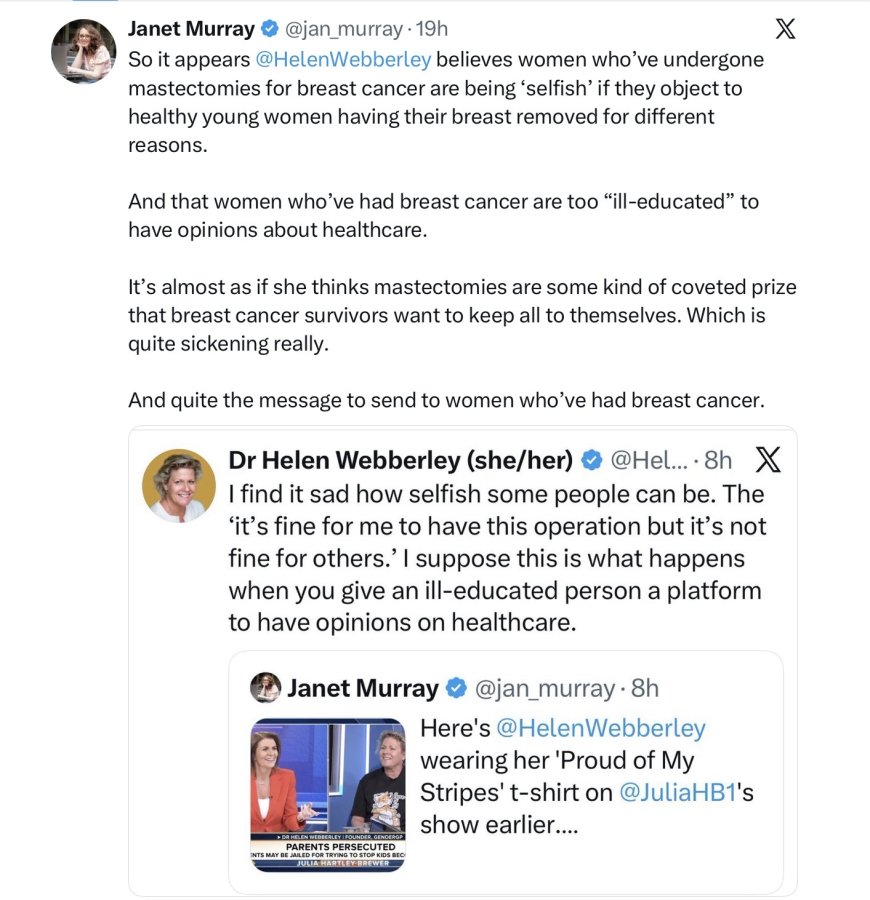
If Webberley couldn’t disgust me more. Imagine calling women who’ve had breast cancer selfish. They are not having a needless procedure carried out, they are having life saving surgery. Then she comes up with her favourite, of course everyone else is too ill informed about healthcare to be entitled to an opinion. Says the absolute insane quack who doesn’t understand what male and female mean, and isn’t allowed to practice.

One of the comments “Queen Camilla hosting J K Rowling during Pride Month is sending the trash into apocalyptic rage. I’m loving every second. Just a reminder, men cannot be women”
I told you she gets around!
If you’re going to try and gatekeep an entire 1/12 of a year (more than that when you take into account other individual days/weeks for the various subgroups of LGBTQ+), you should accept that other people will just get on with their lives  Feels like pride month has dragged onto a whole year at this point
Feels like pride month has dragged onto a whole year at this point- Status
- Thread locked. We start a new thread when they have over 1000 posts, click the blue button to see all threads for this topic and find the latest open thread.