
Have you seen the photos of the man who took this and others of the time? https://www.messynessychic.com/2017...ho-documented-americas-skyline-in-the-making/Lunch atop a skyscraper. Taken when the Rockefeller centre was being built. When you go there you can recreate it by sitting on a metal beam with a screen underneath that makes you think you’re suspended hundreds of feet above the air. My mum almost had a panic attack as she hates heights
View attachment 2551926

New to Tattle Life? Click "Order Thread by Most Liked Posts" button below to get an idea of what the site is about:


Wow those photographs are amazing! How were they able to balance so easily? Would it not be windy that far up? How were they not blown off?Have you seen the photos of the man who took this and others of the time? https://www.messynessychic.com/2017...ho-documented-americas-skyline-in-the-making/
So many questions....


I’ve always found this a memorable photo. It’s from 1973 and is of an IRA volunteer in Belfast, taken by Colman Doyle.
I think it’s the mixture of a woman in a short skirt and long hair juxtaposed with her holding an assault rifle.
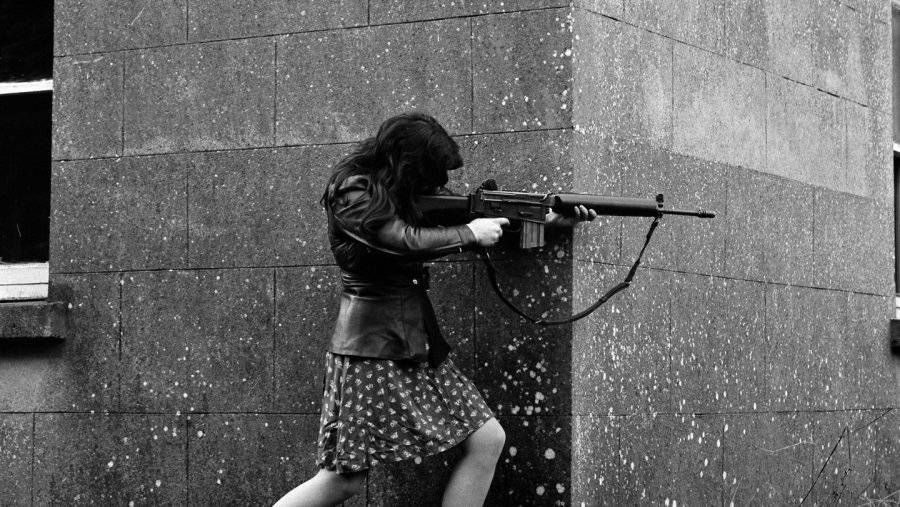
The photographer said that the press refused to print this image at the time: ‘"I offered the photo to the Irish Press", Doyle remembers, "but the editors refused to print it in the paper. They considered it inappropriate to print a photo showing a woman with a gun". These were the 1970s, after all.’
I think it’s the mixture of a woman in a short skirt and long hair juxtaposed with her holding an assault rifle.
The photographer said that the press refused to print this image at the time: ‘"I offered the photo to the Irish Press", Doyle remembers, "but the editors refused to print it in the paper. They considered it inappropriate to print a photo showing a woman with a gun". These were the 1970s, after all.’

Bonnie Parker, of Bonnie and Clyde fame. The photo above of the IRA volunteer reminded me of this iconic one. An interesting character, especially for the times she lived in.
She was only 23 when she was killed in an ambush by law enforcement in Louisiana in 1934.

She was only 23 when she was killed in an ambush by law enforcement in Louisiana in 1934.

Not really iconic - but you may get a kick out of this one.
In 1949 a woman went to have her camera film developed. As she got to the store she realised she still had one shot left to take, so snapped a picture of this young lad who was outside with his bike. She literally could've taken a photo of anything - the shop, a car, the sky. But something made her choose this ordinary boy.
The photo was taken in Memphis - just 5 years later this young lad would walk into a studio in the same city and record a song that would change history - his name: Elvis Presley.
In 1949 a woman went to have her camera film developed. As she got to the store she realised she still had one shot left to take, so snapped a picture of this young lad who was outside with his bike. She literally could've taken a photo of anything - the shop, a car, the sky. But something made her choose this ordinary boy.
The photo was taken in Memphis - just 5 years later this young lad would walk into a studio in the same city and record a song that would change history - his name: Elvis Presley.
Attachments
-
 38.6 KB

I put theWow those photographs are amazing! How were they able to balance so easily? Would it not be windy that far up? How were they not blown off?
So many questions....
 reaction, not laughing at you, but because I get the same thoughts and questions from those pictures! Just, HOW??
Plus you know today that Health and Safety wouldn't let you even attempt to react it without say green screen.I put the

I know he is mental, so it might not count. I see no reason why he or the studio allowed this. ( I can't stand the man) I wouldn't do it.
How Life Begins – Lennart Nilsson (1965)
This is the first image of a developing foetus. It kick-started questions and ideas surrounding birth. The foetus is 18 weeks old and perfectly formed. Before this famous photograph, we have never seen the inside of a womb, and how a baby developed from a fertilised egg to a baby, ready to be born. Photographed in Stockholm, the foetus was delicately placed in a manner that it appeared to float. This was to give the impression of a womb. Lennart Nilsson who took the photograph was a photographer and scientist.
It resonated deeply with viewers, sparking conversations about the beginnings of life and the marvels of human existence. It served as a powerful reminder of the shared journey we all embark upon, fostering a sense of awe and appreciation for the miracle of life. Nilsson's groundbreaking work continues to inspire and contribute to our understanding of human development and the remarkable nature of the human body.
Giles Duley amazes me - he is now known for his photography of humanitarian issues and the consequences of conflict. While he was on his travels in Afghanistan on foot patrol in 2011 he stepped on an IED (improvised explosive device) as a result of which he became a triple amputee. He was told he could never walk again but is quoted as saying to the doctors, “Right hand? Eyes?” and realising they were still intact he said, “ I am still a photographer” and returned to Afghanistan less than 18 months later. His TED Talk is worth watching.
His photographs blow my mind - here some he took showing the lives of children living in war zones around the world. https://www.dazeddigital.com/art-ph...he-face-of-war-photo-series-save-the-children
His photographs blow my mind - here some he took showing the lives of children living in war zones around the world. https://www.dazeddigital.com/art-ph...he-face-of-war-photo-series-save-the-children

This popped up on FB and I thought it was amazing.
Two women in a New York cafe, 1966, by Diane Arbus.

Two women in a New York cafe, 1966, by Diane Arbus.

Endurance in 1915 trapped in the ice, before she was crushed. She found in 2022, 3000 meters below.
Attachments
-
 39.3 KB
 -
 89 KB
89 KB
Working as an investigative photographer for the National Child Labor Committee, Lewis Hine believed that images of child labor would force citizens to demand change. The muckraker conned his way into mills and factories from Massachusetts to South Carolina by posing as a Bible seller, insurance agent or industrial photographer in order to tell the plight of nearly 2 million children. Carting around a large-format camera and jotting down information in a hidden notebook, Hine recorded children laboring in meatpacking houses, coal mines and canneries, and in November 1908 he came upon Sadie Pfeifer, who embodied the world he exposed. A 48-inch-tall wisp of a girl, she was “one of the many small children at work” manning a gargantuan cotton-spinning machine in Lancaster, S.C. Since Hine often had to lie to get his shots, he made “double-sure that my photo data was 100% pure—no retouching or fakery of any kind.” His images of children as young as 8 dwarfed by the cogs of a cold, mechanized universe squarely set the horrors of child labor before the public, leading to regulatory legislation and cutting the number of child laborers nearly in half from 1910 to 1920.

There is a bigger version of the Edna Cintron photo where you can clearly see what looks like a human arm poking out of the hole. I’ve never liked looking at it for that reason
Watching a bit of a Blondie programme last night and they mentioned this 'tea party' with other women in music.
1980.
Debbie Harry, Viv Albertine (The Slits), Siouxie Sioux
Chrissie Hynde, Poly Styrene, Pauline Black

1980.
Debbie Harry, Viv Albertine (The Slits), Siouxie Sioux
Chrissie Hynde, Poly Styrene, Pauline Black
It's refreshing how normal they look.Watching a bit of a Blondie programme last night and they mentioned this 'tea party' with other women in music.
1980.
Debbie Harry, Viv Albertine (The Slits), Siouxie Sioux
Chrissie Hynde, Poly Styrene, Pauline Black
View attachment 2579832
this photo scares the tit out of me

Photo taken in Wigan in the 1930s, was often used over the years to depict the poverty and hopelessness for the working classes at the time.
It was always thought to be a destitute unemployed father and two of his children, was later revealed to be a man staying at a local doss house and two local children.
The photo was much later used as the cover for Orwell’s book The Road To Wigan Pier.
It was always thought to be a destitute unemployed father and two of his children, was later revealed to be a man staying at a local doss house and two local children.
The photo was much later used as the cover for Orwell’s book The Road To Wigan Pier.
Attachments
-
 24.7 KB

This is quite interesting. Photos of iconic moments or things from a different perspective. The faces watching 9/11 unfold is chilling as we so often see the tower or people running. The I have a dream one too I’d never considered.

 marspeta.com
43+ Different, Rare Angles of Iconic Events and Places - MARSPETA
The Alternate Angles community on Reddit has a vibe of surprising you with things you thought you knew well. They show different angles of famous things that you might not have seen before. Ever wondered how the Statue of Liberty looks from the top? They have a photo of that! This community...
marspeta.com