

There's nothing to stop distant relatives or other people wanting to change their names to sound more connected or posh. It's been done for centuries. Just look at the Boleyns. They're a classic example. It doesn't mean that they are actually close family or posh. The majority of Clan Mar will have very many different surnames.Colin and Marilyn definitely weren’t clan chiefs or the children of clan chiefs, they were just clan members. I’ve googled Colin and his main claim to fame seems to be advising Guardian readers to be cautious about investing in Viagra and Marilyn works for a charity for working horses. You can google the clan chiefs and their children and they are definitely more distant than that but use the style.
The paragraph you posted earlier clearly said the Mountbatten-Windsor surname was only for non-HRHs. It’s really not that complicated.
Philip wanted all their descendants to have Mountbatten-Windsor, the establishment wanted none of them to have it and all have the name Windsor. TLQ was in the middle and they eventually reached the compromise that Mountbatten-Windsor would be used except for those who had an HRH and females who married. It says the same thing clearly in what you posted!
There you go, when they need to use a surname for legal purposes, their surname is M-W. All the then Queen's children had HRH and Prince/Princess titles but, recognising that they would need a surname at times, they would then use M-W. Those without titles need the surname at all times but those that do have titles will need to use the surname M-W for legal occasions. It's in line with normal aristocratic and royal nomenclature. You can see this in Sweden with the Bernadottes, particularly those who had their princely titles removed in previous generations."The effect of the declaration was that all The Queen's children, on occasions when they needed a surname, would have the surname Mountbatten-Windsor.
"For the most part, members of the Royal Family who are entitled to the style and dignity of HRH Prince or Princess do not need a surname, but if at any time any of them do need a surname (such as upon marriage), that surname is Mountbatten-Windsor."
You can see that the royal family website refers to some members not using a surname not that they don't have one. They have had one since 1917 (incidentally the same time as the Battenbergs became the Mountbattens) and Elizabeth merely included Philip's surname for their descendants.People often ask whether members of the Royal Family have a surname, and, if so, what it is. Members of the Royal Family can be known both by the name of the Royal house, and by a surname, which are not always the same. And often they do not use a surname at all.
Before 1917, members of the British Royal Family had no surname, but only the name of the house or dynasty to which they belonged.
...
In 1917, there was a radical change, when George V specifically adopted Windsor, not only as the name of the 'House' or dynasty, but also as the surname of his family. The family name was changed as a result of anti-German feeling during the First World War, and the name Windsor was adopted after the Castle of the same name.
At a meeting of the Privy Council on 17 July 1917, George V declared that 'all descendants in the male line of Queen Victoria, who are subjects of these realms, other than female descendants who marry or who have married, shall bear the name of Windsor'.
The Royal Family name of Windsor was confirmed by The Queen after her accession in 1952. However, in 1960, The Queen and The Duke of Edinburgh decided that they would like their own direct descendants to be distinguished from the rest of the Royal Family (without changing the name of the Royal House), as Windsor is the surname used by all the male and unmarried female descendants of George V.
It was therefore declared in the Privy Council that The Queen's descendants, other than those with the style of Royal Highness and the title of Prince/Princess, or female descendants who marry, would carry the name of Mountbatten-Windsor.
Last edited:


 Andy & Mandy will be sorry they crossed him

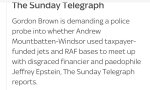

 did you read about the young child that was ( apparently) trafficked in by Epstein
 remember Mandy was NI Secretary of State at one time, Seamus Mallon couldn’t stand him …Just need to wait to hear who the sickos are now ( north & south) Epstein touched down in Shannon plenty of times.


 )
 that’s why one is keeping one’s comment impact vague x